
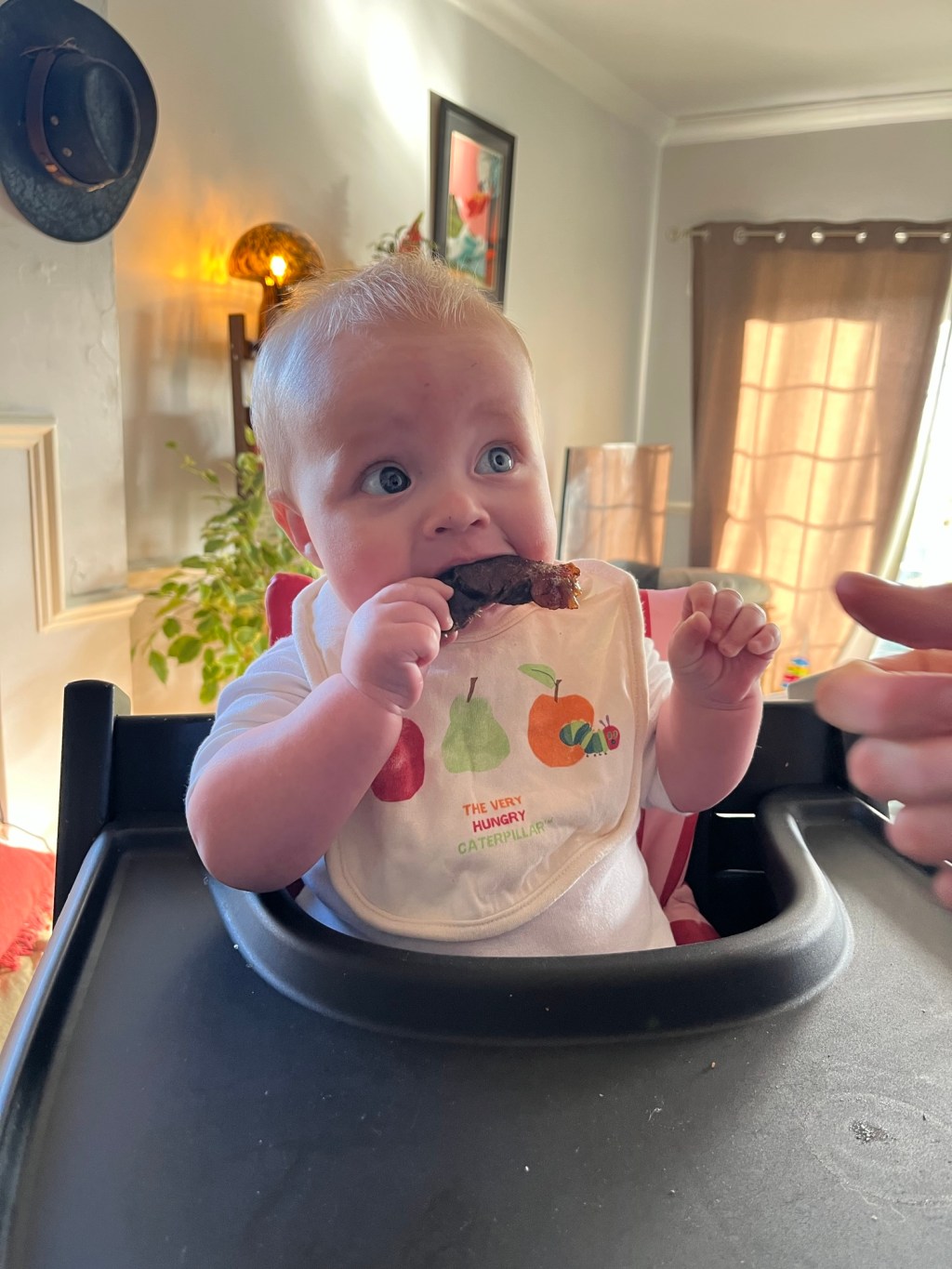
Welcome again, everyone! Today we’re going to be talking about feeding your baby for the first time.
There is a craze taking over the internet: baby-led weaning. You see the videos of babies eating a piece of steak and think, that’s hilarious. But what actually is it? Is this the best way to feed your child? And, most importantly, is it safe?
Let’s dig in.
What actually is baby-led weaning?
Before we start to answer that, let’s make sure we’re all on the same page.
Complementary feeding is generally recommended from around 6 months, when your baby is developmentally ready. There are three key signs that your baby is ready to start eating solid foods:
- They can stay in a sitting position and hold their head steady.
- They can coordinate their eyes, hands and mouth so they can look at food, pick it up and put it in their mouth.
- They can swallow food rather than automatically pushing it back out.
These signs should be present together before you start introducing solid foods.
At the beginning, solid food is complementary to breast milk or first infant formula. Your baby will continue to get a large proportion of their nutrition from milk while they gradually learn to eat more food.
Baby-led weaning traditionally means offering babies appropriately prepared finger foods and allowing them to feed themselves, rather than primarily relying on an adult to spoon-feed them.
This is where the baby sucking on a piece of steak or chewing on a chicken drumstick comes in!
Whilst many parents choose BLW, you may also see parents offering mashed or puréed foods alongside finger foods. And that’s absolutely okay.
A big part of introducing food is allowing your baby to explore different textures, smells, tastes and sensations. And yes, that does mean a lot of it will end up on the floor.
And that is completely normal.
What is BLISS?
You may also come across the term BLISS, which stands for Baby-Led Introduction to SolidS.
BLISS is a modified baby-led approach that was developed by researchers to address some of the concerns surrounding traditional BLW, particularly around iron intake, energy intake and choking.
It encourages parents to include an iron-rich food, an energy-rich food and a fruit or vegetable at meals, alongside guidance about preparing food safely.
So if you see someone combining self-feeding with mashed foods, pre-loaded spoons or other approaches, they aren’t necessarily “doing BLW wrong”. Feeding doesn’t have to fit perfectly into one box.
Is baby-led weaning safe?
Whilst you may see people online saying that research proves BLW is the safer way to feed your baby long term, the evidence isn’t quite that simple.
Current research does not suggest that an appropriately implemented baby-led approach causes more choking than traditional spoon-feeding. However, that absolutely does not mean that BLW means your baby will never choke.
There is a risk of choking with any method of feeding, which is why knowing how to prepare food safely and supervising your baby while they eat is so important.
And this brings us to something that can be really scary for new parents…
Gagging vs choking
There is a big difference between gagging and choking.
Gagging is a normal protective reflex. When babies are learning to manage new textures, they will often gag, and it can be very loud and dramatic!
Choking is different. A choking baby may be unable to breathe, cough or make a sound, and it requires immediate action.
I’m going to do a whole blog post on gagging and choking, so keep your eyes peeled — or have a look through my other posts, as it may already be up when you’re reading this.
For now, the important thing to remember is that gagging can be a normal part of learning to eat. Try to stay calm and closely observe your baby. If your baby is choking and cannot breathe properly, you need to act immediately.
The perfect baby plate
When your baby reaches around 6 months, there are a few nutritional things to consider.
One of these is iron. A baby’s stores of iron begin to decrease around this time, which is why it is important to regularly offer iron-rich foods.
It’s also worth remembering that babies have very small stomachs, but their nutritional needs are high. This means that the quality and variety of the food we offer matters.
A really simple framework to think about when putting together a meal is:
Iron + Energy + Colour
Iron-rich foods:
- Soft, shredded meat
- Flaky fish
- Well-cooked egg
- Beans
- Lentils
- Chickpeas and hummus
- Iron-fortified cereals
Energy-rich foods:
- Avocado
- Full-fat yoghurt
- Cheese
- Nut or seed butters, prepared appropriately
- Olive oil
- Eggs
- Oily fish
Fruit and vegetables:
- Broccoli
- Spinach
- Sweet potato
- Berries
- Pear
- Banana
- Cauliflower
- Peppers
You don’t need to create the perfect plate at every single meal. Think about variety across the day and week rather than stressing about one meal.
Current research doesn’t show that an appropriately implemented BLW approach causes poorer growth compared with traditional feeding, but there also isn’t strong evidence that BLW improves growth.
So once again, it’s not about finding the “perfect” feeding method. It’s about making sure your baby is getting the nutrition they need.
Responsive feeding
Something that is often skimmed over when talking about BLW is the fact that it is baby-led.
We talk about how to prepare the food and what we should give them, but where is the baby-led part?
A baby-led approach can provide opportunities for responsive feeding.
You decide:
What food is offered
When food is offered
Where food is offered
Your baby gets to decide:
Whether they eat
How much they eat
How they explore the food
This can take some of the pressure out of mealtimes.
Babies are learning. They’re exploring food, getting messy, feeling different textures, smelling different foods and experiencing a huge variety of tastes.
It also gives them the opportunity to participate in family mealtimes, experience different appetites and repeatedly encounter foods without being forced to eat them.
And this is something I really want to emphasise:
You don’t have to choose BLW as an identity.
You can take the principles that you like and make them work for you, your baby and your family.
Maybe your baby feeds themselves some broccoli but has yoghurt from a pre-loaded spoon.
Maybe you offer them a piece of toast alongside some mashed avocado.
Maybe one day they eat everything and the next day they throw everything on the floor.
That’s okay.
So, what are the benefits of baby-led weaning?
BLW seems to be spoken about all the time, and so far I’ve probably sounded like I’m busting the myth that it is automatically “better”.
And that’s because the research doesn’t currently show that BLW is universally superior to traditional spoon-feeding.
However, there are some interesting findings.
Some studies have found differences in eating behaviours among children who followed a baby-led approach, including lower reported food fussiness in some children by around two years old.
But this does not mean that BLW prevents picky eating.
Children will still have their fussy moments. And, let’s be honest, sometimes it has very little to do with the food you’ve lovingly prepared!
Children are learning about independence and control, and food can become one of the areas where they exercise that independence.
Sometimes they’re hungry.
Sometimes they’re not.
Sometimes they loved broccoli yesterday and apparently have decided today that broccoli is the worst thing ever invented.
Welcome to feeding a toddler.
How to serve food BLW style
If you went onto TikTok right now and typed in “baby-led weaning”, I’m sure you’d see a video of a baby eating avocado sticks, cucumber sticks, banana sticks and a slice of steak.
You’ll probably also find recipes for turning everything into a stick shape.
Stick oat bars.
Stick biscuits.
Stick toast.
But does everything have to be in a stick form?
Not at all.
Food should be prepared in a way that is appropriate for your baby’s developmental stage. For some foods, larger, soft pieces that a baby can hold can be useful when they are first learning to self-feed.
You can also offer mashed foods and foods on a pre-loaded spoon.
For example, if you’re offering yoghurt, you could give your baby a pre-loaded spoon to explore and use themselves. You can also have another spoon available if you want to help them get some food into their mouth.
You can steam fruit or vegetables to make them soft enough for your baby to manage.
The aim isn’t to make every food look like an Instagram-worthy BLW meal.
It’s to give your baby safe opportunities to learn how to eat.
Foods need adapting
Some foods need to be modified to reduce choking risk.
For example:
- Grapes and cherry tomatoes should be cut appropriately rather than given whole.
- Hard raw vegetables such as raw carrot need to be softened or prepared appropriately.
- Whole nuts should not be given to babies because of the choking risk. Nut butters can be offered in an appropriate form.
- Meat should be soft and prepared appropriately, with bones removed.
- Foods should generally be soft enough to be easily mashed with your fingers when your baby is first starting solids.
Always check current NHS guidance for the specific food you’re offering, as preparation matters.
Introducing allergens
Another important part of starting solids is introducing common allergens.
Common allergens should not be unnecessarily delayed once your baby is ready for complementary foods.
Examples include:
- Well-cooked egg
- Peanut
- Dairy
- Wheat
- Fish
- Soya
- Sesame
Introduce new allergens in small amounts and one at a time, so that if your baby does have a reaction, it is easier to identify which food caused it.
If your baby tolerates an allergen, current guidance recommends continuing to offer it regularly as part of their diet.
If your baby has eczema, an existing food allergy or you have particular concerns about allergies, speak to your GP or health visitor for individual advice.
What should my baby drink?
Once your baby starts solids at around 6 months, you can offer small amounts of water with meals and begin introducing them to drinking from a cup.
Breast milk or first infant formula will continue to be an important source of nutrition during the first year.
Food is complementary — it isn’t suddenly replacing milk overnight.
My experience with introducing foods
When it came to feeding my son for the first time, I was so overwhelmed.
There were so many things that I should do or shouldn’t do.
After speaking to friends who had babies older than mine, I very quickly determined that I had a hungry baby!
For that reason, although I loved the exploration and key principles that underpin BLW, I wanted to make sure he was actually getting some food into his stomach.
I offered Harrison a mixture of mashed and finger foods.
I’d have broccoli florets alongside some broccoli blended with his usual milk, paired with some yoghurt.
I wanted him to explore the whole food, but I also wanted to feel confident that he was actually getting some food.
But boy, was I ready for the mess?
No.
And I have worked in early years for nearly 10 years.
I had never in my life wished I had a dog more to hoover everything up.
They say they’re going to explore, and boy, did he explore.
Whether it was all over himself or all over the floor, there were points where I was sure he didn’t actually eat anything and had simply thrown it all around the room.
I actually really loved the beginning phase.
Introducing him to new foods and flavours was so exciting. At this stage, he wanted to try everything, and even if he didn’t seem to like something, he’d often go back to it again.
Repeated exposure is important when babies are learning about new foods. The NHS notes that it can take 10 or more attempts for a baby to accept a new food or texture, so don’t assume that a food is permanently off the menu just because they pulled a face the first time!
I quickly realised something else:
One meal does not determine their whole diet.
I learnt to look at his diet across the whole week.
Some days he’d eat nearly two Weetabix and still be wanting more.
Other days he’d eat one piece of steamed pear and decide he was completely finished.
And that’s okay.
I chose to introduce vegetables before offering lots of fruit because I wanted him to experience a variety of flavours, including less-sweet vegetables.
I found that once he started eating more fruit, his interest in vegetables definitely dwindled, so personally, I’m glad I did it that way.
I’ve never known a baby to love blackberries as much as my boy. He would have eaten a whole punnet if I’d let him!
Was it perfect?
No.
But did I always feel comfortable with what I was doing?
Yes.
And that, for me, was really important.
I honestly really enjoyed this part of parenthood. I listened to my baby, I paid attention to what worked for us and I adapted things when I needed to.
Did I oven-steam things because I was worried they were too hard?
Yep.
Would I do it again?
Definitely.
Because it made me feel comfortable.
And I think that’s the key.
You don’t have to follow someone else’s feeding journey perfectly. You need to find an approach that keeps your baby safe, gives them the nutrition they need and feels manageable for your family.
Baby safety
Now for the bit that’s really going to help you stay calm: making sure you’re doing it safely.
Remember:
Babies should show the signs that they are developmentally ready before starting complementary foods.
Always supervise your baby while they are eating. Don’t leave them unattended with food.
Make sure your baby is sitting upright and appropriately supported while eating.
Learn the difference between gagging and choking and know what to do in an emergency.
Prepare food appropriately for your baby’s developmental stage. Some foods need to be cooked, softened, cut or modified to reduce choking risk.
Introduce common allergens when your baby is ready, rather than unnecessarily delaying them, and continue to offer tolerated allergens regularly.
Breast milk or first infant formula remains an important source of nutrition during the first year. Food is complementary and gradually becomes a bigger part of their diet.
And, as always, please check the current NHS guidance on introducing solid foods, choking, food preparation and allergens for the most up-to-date safety advice.
If you have concerns about whether your baby is ready to start solids, speak to your health visitor, GP or another appropriately qualified healthcare professional.
My biggest takeaway
If there is one thing I want you to take away from this blog post, it’s this:
You don’t have to do it perfectly.
There isn’t one magical way to feed your baby.
You can use finger foods.
You can use mashed foods.
You can use a pre-loaded spoon.
You can do a mixture of everything.
What matters is that your baby is ready, their food is prepared safely, they’re getting the nutrients they need and you’re creating a positive environment around food.
Trust your gut.
Find what works for you and your family.
And remember that your baby’s first year of food is about learning, not perfection.
You’ve got this, mama. 🤍 xx


Leave a Reply